
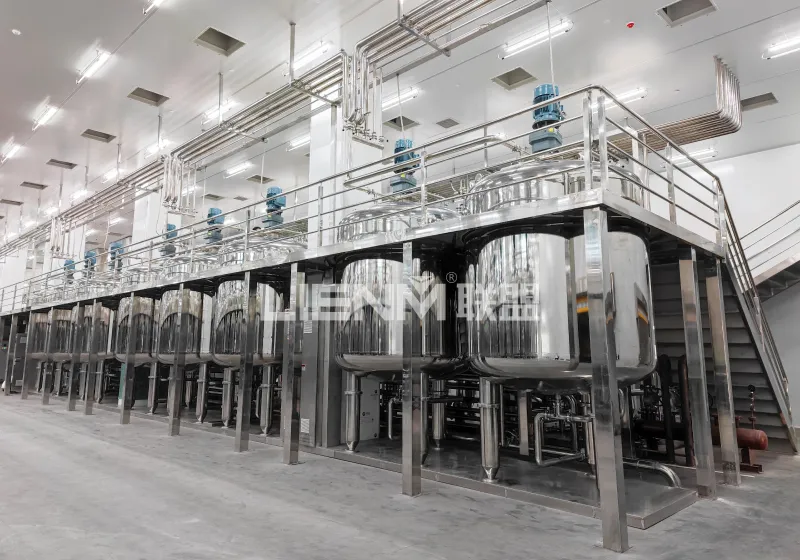
Mixing ingredients in cosmetic production may seem simple, but achieving consistent quality requires precise equipment and processes. When handling large volumes or combining ingredients with different properties, selecting the right industrial mixer is critical. Industrial mixers play a vital role in cosmetic production equipment, helping manufacturers produce lotions, creams, serums, shampoos, conditioners, and other products efficiently. In this article, we explore seven common mixing machines, their functions, performance, market prices, major international suppliers, practical considerations, and industry applications.
Industrial Mixer Categories
Industrial mixers can be categorized in several ways: by design, material, mixing force, or function. Some handle liquids, powders, or viscous materials, while others work with immiscible substances. The choice of cosmetic production equipment depends on the type of ingredients, production scale, and desired consistency. Key considerations include:
- Industry: Mixers are designed for cosmetics, pharmaceuticals, and food processing.
- Material: They can mix powders, liquids, or semi-solids.
- Force: Mixers may use rotation, gravity, pressure, or shear to achieve a homogeneous blend.
- Function: Some create stable emulsions, while others efficiently combine ingredients.
Applications of Industrial Mixers
Industrial mixers are widely used across multiple industries due to their versatility and efficiency.
- Cosmetics: Lotions, creams, serums, masks, shampoos, conditioners, and other personal care products require precise mixing to ensure consistent texture, stability, and performance. Emulsifiers, planetary mixers, and paddle mixers are commonly used.
- Food Industry: Mixers handle doughs, sauces, dressings, spices, and beverages. High-speed mixers, ribbon blenders, and planetary mixers help achieve uniformity while preserving ingredient quality.
- Pharmaceuticals: Powders, granules, ointments, and liquid formulations require precise mixing to meet strict quality and safety standards. Tumbler mixers, ribbon blenders, and emulsifiers are widely used.
- Chemicals & Plastics: Industrial mixers blend pigments, resins, adhesives, and polymers. Ribbon mixers, drum mixers, and static mixers are typical choices.
- Other Applications: Paints, detergents, cosmetic packaging compounds, and specialty chemicals benefit from industrial mixers for uniform product consistency and reduced production time.
7 Types of Industrial Mixers Introduction

1. Horizontal Ribbon Mixer
Horizontal ribbon mixers, also called ribbon blenders, use two intertwined metal strips to move material from one side to the other. This ensures thorough mixing of powders, granules, and other bulk materials in cosmetic production, such as pigments for creams and face powders.
Key Details:
- Performance: Dual-helix ribbon design; high uniformity; easy cleaning.
- Applications: Dry powders, granules, and bulk cosmetic raw materials.
- Advantages: Precise mixing; scalable; low contamination risk.
- Challenges: Overloading may reduce uniformity; not ideal for very viscous materials.
- Major Suppliers: Ross Mixers (USA), Gimat Engineering (Italy).
- Maintenance Tips: Inspect ribbons for wear; clean thoroughly to prevent cross-contamination.

2. Paddle Mixer
Paddle mixers use rotating paddles to gently move materials, creating a cohesive blend without excessive shear. Ideal for viscous products such as creams, gels, and lotions.
Key Details:
- Performance: Gentle, consistent mixing; handles viscous semi-solids.
- Applications: Creams, lotions, gels.
- Advantages: Reduces risk of ingredient damage; suitable for heat-sensitive materials.
- Challenges: Less effective for suspensions of solids; slower than high-speed mixers.
- Major Suppliers: Lancaster Products (USA), VMI Mixing (France).
- Maintenance Tips: Ensure paddles are aligned; avoid overfilling.

3. Tumbler Mixer
Tumbler mixers rotate materials in a drum or cone using gravity. Variants include V-shaped, double-cone, and slant mixers.
Key Details:
- Performance: No agitator needed; gentle on sensitive materials.
- Applications: Powder blends, granules, liquid additives.
- Advantages: Versatile; preserves material integrity; simple design.
- Challenges: Large footprint; slower mixing; unsuitable for high-viscosity liquids.
- Major Suppliers: GEMCO, Bio-Components.
- Maintenance Tips: Clean regularly; inspect seals to prevent leakage.

4. Drum Mixer
Drum mixers consist of large rotating tanks that mix and temporarily store low to medium viscosity materials, such as slurries, gels, and emulsions.
Key Details:
- Performance: Handles large volumes; simple; easy operation.
- Applications: Cosmetic gels, low-viscosity creams.
- Advantages: Cost-effective; flexible for batch changes.
- Challenges: Limited precision for highly viscous products.
- Major Suppliers: DENIOS, Tapflo.
- Maintenance Tips: Clean drums after each batch; monitor rotation speed.

5. Static Mixer
Static mixers contain no moving parts; mixing occurs as liquids or gases pass through fixed internal elements.
Key Details:
- Performance: Continuous, efficient; low maintenance.
- Applications: Continuous blending of cosmetic liquids, emulsions, or gas-liquid mixtures.
- Advantages: Simple; energy-efficient; minimal wear.
- Challenges: Limited capacity; effectiveness depends on flow and viscosity.
- Major Suppliers: UET Mixers, EW Process.
- Maintenance Tips: Inspect internal elements; flush system after batch changes.

6. Planetary Mixer
Planetary mixers use a circular, planetary motion to mix high-viscosity materials, ensuring uniform blending of creams, masks, and pastes.
Key Details:
- Performance: Uniform mixing; ideal for thick creams and pastes.
- Applications: Creams, facial masks, hair care pastes.
- Advantages: Thorough mixing; versatile agitators.
- Challenges: Requires high power; slower for large batches.
- Major Suppliers: Gansons, VMI Mixing.
- Maintenance Tips: Check planetary gears; clean bowls after each batch.

7. Emulsifier
Emulsifiers combine immiscible liquids, like oil and water, into stable emulsions.
Key Details:
- Performance: High-pressure mixing; stable emulsions.
- Applications: Lotions, creams, serums; pharmaceuticals; food emulsions.
- Advantages: Produces smooth, uniform formulations; scalable.
- Challenges: Requires proper energy input; maintenance of high-pressure components.
- Major Suppliers: 3V Sigma, Accio.
- Maintenance Tips: Inspect high-pressure components; clean emulsification chamber.
Top 5 Industrial Mixer Manufacturers Worldwide
For anyone looking to source reliable industrial mixers globally, it’s essential to know the top manufacturers in the market. Check out the Best 10 Mixing Machine Suppliers for detailed information on leading brands and their specialized equipment.
| Manufacturer | Country | Specialization | Website |
|---|---|---|---|
| LIENM | China | Cosmetic & Pharmaceutical Mixers | Lienm |
| Ross Mixers | USA | Ribbon, Paddle, High-Shear Mixers | Ross Mixers |
| Gimat Engineering | Italy | Industrial Ribbon & Paddle Mixers | Gimat Engineering |
| VMI Mixing | France | Planetary & High-Viscosity Mixers | VMI Mixing |
| 3V TECH | Italy | Emulsifiers & Cosmetic Mixers | 3V Sigma |
Choosing the Right Industrial Mixer
Selecting the appropriate industrial mixer for your cosmetic production equipment ensures consistent quality and efficiency. Consider ingredient type, viscosity, batch size, and mixing time when choosing a machine. Professional suppliers can guide you to the best mixing machines for your production line.
Industrial Mixers FAQ
1. How Many Types of Mixers Are There?
- There are several types of industrial mixers, including horizontal ribbon mixers, paddle mixers, tumbler mixers, drum mixers, static mixers, planetary mixers, and emulsifiers. Each type is designed for specific materials and applications.
2. What Are the Different Types of Commercial Mixers?
- Commercial mixers include planetary mixers, ribbon mixers, paddle mixers, and high-shear emulsifiers. They are widely used in cosmetic, food, pharmaceutical, and chemical industries to blend powders, liquids, and viscous materials.
3. Cosmetic Mixing Equipment Types
- In cosmetic production, common mixing equipment includes paddle mixers, planetary mixers, emulsifiers, and ribbon mixers. These machines ensure consistent texture, stability, and quality in creams, lotions, serums, and gels.
4. Types of Mixers in Pharmaceutical Industry
- Pharmaceutical mixers include tumbler mixers, ribbon blenders, planetary mixers, and static mixers. They are used for powders, granules, ointments, and liquid formulations to maintain strict quality and safety standards.
5. Types of Mixer in Construction
- Construction mixers include drum mixers, concrete mixers, and mortar mixers. They efficiently mix cement, sand, gravel, and other building materials for construction projects.
6. Industrial Mixer Machine Price
- The price of industrial mixers varies depending on type, capacity, and supplier:
- Ribbon mixers: $980 – $1,580 USD
- Paddle mixers: $28,999 – $29,999 USD
- Planetary mixers: $6,500 – $14,300 USD
- Emulsifiers: ~$9,000 USD
- Prices may fluctuate based on batch size, material compatibility, and additional features.