

In cosmetic manufacturing, especially in moisturizing cream production, maintaining product stability, hygiene, and consistency is critical. One key piece of equipment that directly affects these factors is the cosmetic cream storage tank.
Whether used for intermediate holding or final product storage before filling, the right storage tank plays an essential role in ensuring smooth production and consistent cream quality. For a complete workflow, you can refer to Cream Manufacturing for more details on the overall process.
This article explains what a cosmetic cream storage tank is, its main types, and how it is used in modern cream manufacturing lines.

Cream Storage Tanks
What Is a Cosmetic Cream Storage Tank?
A cosmetic cream storage tank is a stainless steel vessel designed to temporarily store emulsified cream products during different stages of production.
It is typically positioned after emulsification and cooling, and before filling and packaging.
Unlike raw material tanks, cream storage tanks must handle:
- Medium to high viscosity products
- Stable emulsions
- Strict hygienic and GMP requirements
In moisturizing cream manufacturing, storage tanks act as a buffer unit, allowing continuous production and stable feeding into filling machines. This stage often works in conjunction with equipment detailed in Vacuum Emulsifying Mixer guides to ensure consistent texture and quality.

Why Storage Tanks Are Critical for Cream Quality
After emulsification, cosmetic creams remain sensitive to environmental and mechanical conditions. Without proper storage, issues such as separation, texture changes, or contamination may occur before the product even reaches the filling stage.
This is why storage tanks are not simply containers, but an essential quality-control component in the production line.
Using a properly designed storage tank helps manufacturers maintain consistent product quality and reduce production risks. Key benefits include:
- Preventing phase separation during holding
- Maintaining uniform texture and viscosity
- Protecting the cream from contamination
- Ensuring stable temperature control
- Supporting automated filling operations
For moisturizing creams containing active ingredients, poor storage conditions can lead to instability, air bubbles, or texture changes—issues that directly affect product performance and shelf life. For troubleshooting, the Cream Manufacturing Problems guide can be a helpful reference.
Main Types of Storage Tanks for Cosmetic Cream
Cosmetic cream formulations vary widely in viscosity, sensitivity, and production volume. To meet these different requirements, storage tanks are available in multiple designs, each optimized for specific manufacturing needs.
Choosing the right type ensures both product stability and operational efficiency. For a broader perspective on equipment, see Manufacturing Machine Overview.

Stainless Steel Storage Tank
Stainless steel storage tanks are the most widely used solution in cosmetic manufacturing due to their durability and hygienic design. They provide a stable environment for cream products during temporary holding.
Features:
- Made of SUS304 or SUS316L stainless steel
- Mirror-polished inner surface (Ra ≤ 0.4 μm)
- Easy cleaning and corrosion resistance
Suitable for:
- Standard moisturizing creams
- Daily skincare products
- GMP-compliant production lines

Jacketed Storage Tank (Heating / Cooling)
Temperature plays a critical role in maintaining cream texture and flowability. For this reason, many manufacturers choose jacketed storage tanks for better thermal control.
These tanks help stabilize cream properties during holding and transfer.
Advantages:
- Maintains optimal cream temperature
- Prevents hardening or excessive thickening
- Improves stability for high-viscosity products
Commonly used for:
- Thick moisturizing creams
- Creams sensitive to temperature changes
Agitated Storage Tank (With Mixer)
When cosmetic creams are stored for extended periods, even well-emulsified products may experience settling or surface skin formation.
An agitated storage tank addresses this issue by providing gentle, continuous mixing. Detailed operation and selection guidance can be found in Cream Mixing Tank Guide.
Functions:
- Prevents sedimentation
- Maintains homogeneity during holding
- Reduces surface skin formation
Typical agitator types:
- Anchor agitator
- Scraper-type mixer
This type of tank is especially suitable for production lines where filling does not occur immediately after emulsification.
Vacuum Storage Tank
For premium skincare products, minimizing air exposure is a key manufacturing concern. Vacuum storage tanks are designed to protect creams from oxidation and air entrapment during storage.
They are commonly used when product appearance and stability are critical.
Key benefits:
- Eliminates air bubbles
- Reduces oxidation risk
- Improves product appearance and stability
Often used in:
- High-end skincare products
- Creams with sensitive active ingredients

Storage Tank Applications in Cosmetic Cream Production
In a modern cosmetic factory, storage tanks serve multiple operational purposes beyond simple holding. They help balance production speed between different processing stages and support continuous manufacturing.
As a result, they are an indispensable part of automated cream production lines. Integration with downstream equipment such as Cream Filling Machine Introduction ensures smooth transfer and consistent filling.
Cosmetic cream storage tanks are widely used in:
- Temporary storage of finished cream after emulsification
- Buffer storage before automatic filling machines
- Continuous production line coordination
- Multi-batch production management
They are commonly integrated with cream filling machines, transfer pumps, and automated control systems to improve efficiency and reduce manual handling. Auxiliary equipment like About Capping Machine and Sealing Machine Overview often works in tandem to complete packaging operations.
Storage Tank Design Considerations for Cosmetic Cream
Well-designed storage tanks ensure product quality, hygiene, and efficient production. Key design factors include material, structure, agitation, temperature control, sealing, cleaning, automation, GMP compliance, and customization.
- Material & Surface: Stainless steel (SUS304/SUS316L) with mirror-polished interior ensures hygiene and easy cleaning.
- Structure: Conical/dished bottom, rounded corners, and proper outlets allow complete drainage.
- Agitation: Low-speed anchor or scraper agitators prevent separation and maintain uniform texture.
- Temperature Control: Jacketed tanks with heating/cooling and insulation keep cream stable.
- Sealing & Pressure: Airtight covers, mechanical seals, and vacuum capability reduce oxidation and air bubbles.
- Cleaning & Automation: CIP-compatible design and sensors enable efficient cleaning and automated monitoring.
- GMP Compliance: Sanitary welding, traceable materials, and documentation support regulatory standards.
- Customization: Volume, agitator, and inlet/outlet positions can be tailored to production needs.
| Aspect | Key Points | Benefit |
|---|---|---|
| Material & Surface | SUS304/316L, mirror-polished | Hygiene, easy cleaning |
| Structure | Conical/dished bottom, rounded corners | Complete drainage, reduce contamination |
| Agitation | Low-speed anchor/scraper | Prevent separation, maintain texture |
| Temperature | Jacketed heating/cooling, insulation | Stable cream consistency |
| Sealing & Pressure | Airtight, mechanical seals, vacuum | Reduce oxidation, air bubbles |
| Cleaning & Automation | CIP, sensors, PLC/HMI | Efficient cleaning, automated monitoring |
| GMP Compliance | Sanitary welding, traceability | Compliance, audit-ready |
| Customization | Volume, agitator, inlet/outlet | Match production, improve efficiency |

How to Choose the Right Storage Tank for Cosmetic Cream
Selecting a suitable storage tank requires more than just choosing a volume size. Manufacturers must consider product characteristics, production capacity, and regulatory standards.
A well-matched tank ensures stable operation and long-term reliability.
Cream Viscosity and Formula
Different cream formulations behave differently during storage. High-viscosity moisturizing creams typically require:
- Stronger agitators
- Jacketed heating systems
Low-viscosity creams may use simpler holding tanks without advanced temperature control.
Production Capacity
The storage tank volume should align with your production scale and filling speed to avoid bottlenecks.
Typical capacity ranges include:
- Laboratory or pilot scale: 50–200 L
- Medium production: 300–1000 L
- Industrial scale: 2000 L and above
Hygienic and GMP Requirements
Cosmetic production demands strict hygiene standards. A compliant storage tank should be designed to support efficient cleaning and inspection.
Key design elements include:
- CIP (Clean-in-Place) system
- No dead corners
- Sanitary valves and connections
Automation and Line Integration
As cosmetic factories move toward automation, storage tanks must integrate seamlessly with other equipment.
This includes compatibility with:
- Filling machines
- Transfer pumps
- PLC control systems
Proper integration reduces downtime and improves overall production efficiency.

Common Problems with Cream Storage Tanks and Solutions
Even with advanced equipment, improper tank selection or operation can lead to production challenges. Understanding common issues helps manufacturers prevent quality losses.
| Problem | Solution |
|---|---|
| Cream separation | Add slow-speed agitation |
| Hardening during storage | Use jacketed heating |
| Air bubbles | Apply vacuum design |
| Difficult cleaning | Upgrade to CIP structure |
Storage Tank vs Mixing Tank vs Holding Tank
In cosmetic manufacturing, equipment terminology is often used interchangeably, which can cause confusion during system planning.
Clarifying these differences helps manufacturers design more efficient production lines.
- Mixing Tank: Used for blending and emulsification
- Storage Tank: Used for temporary holding after processing
- Holding Tank: Often refers to a storage tank with agitation
In moisturizing cream production, each tank serves a distinct function and should be selected accordingly.
Best Practices for Using Storage Tanks in Cream Manufacturing
Proper operation is just as important as correct equipment selection. Following best practices helps extend equipment life and maintain product quality.
Manufacturers should establish standard operating procedures for storage tank use.
Key recommendations include:
- Control holding time to avoid instability
- Use gentle agitation for long storage
- Maintain consistent temperature
- Follow regular cleaning and maintenance schedules
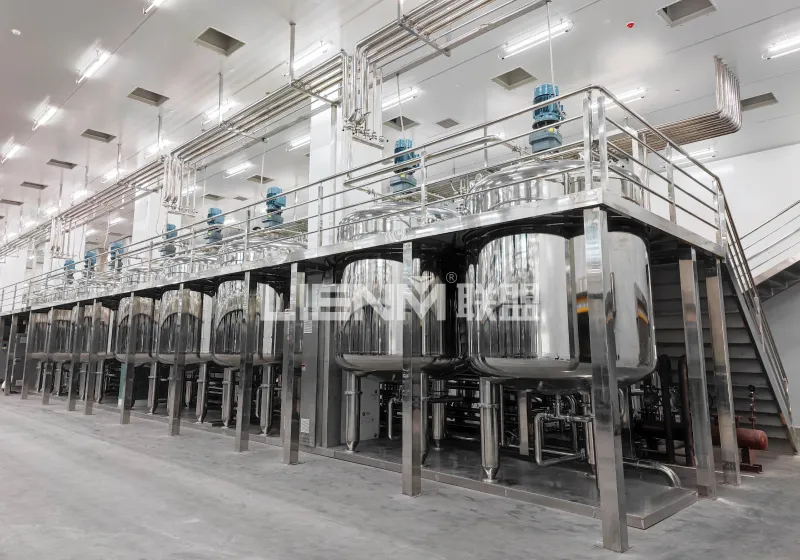
Cream Storage Tanks
LIENM: Serving 500+ CosmeticGlobal Brands
Founded in 1983, LIENM is a China cosmetic equipment manufacturer with 40+ years of experience, offering smart automated lines. Serving over 500 clients in USA, Brazil, Germany, India, Saudi Arabia, UK, Russia, France, Australia, Canada, Mexico, Italy.
In cosmetic cream production, the storage stage directly influences filling efficiency and final product quality.
A well-designed cosmetic cream storage tank ensures stable texture, hygienic handling, and smooth integration with automated filling lines.
By selecting the right tank type—stainless steel, jacketed, agitated, or vacuum—manufacturers can reduce production risks and improve overall process efficiency.
For companies aiming to scale moisturizing cream production while maintaining consistent quality, investing in the right storage tank solution is a critical step.
FAQ
What is a cosmetic cream storage tank used for?
It temporarily holds emulsified or finished cream products between processing stages, ensuring consistent texture, hygiene, and smooth production flow.
What materials are recommended for cosmetic cream storage tanks?
Food- or cosmetic-grade stainless steel, such as SUS304 or SUS316L, is recommended for durability, corrosion resistance, and chemical compatibility.
How often should a storage tank be cleaned?
Tanks should be cleaned after each batch or shift. Clean-in-Place (CIP) systems are ideal for thorough and efficient cleaning without disassembly.
Can a storage tank handle multiple products like lotions, serums, or creams?
Yes, with proper cleaning between batches and compatible materials, a single tank can store different cosmetic products safely.
Do storage tanks need temperature control?
Yes, jacketed tanks with heating or cooling help maintain consistency and stability for high-viscosity or heat-sensitive creams.
Are storage tanks required to meet GMP standards?
Yes, tanks should follow GMP with hygienic design, traceable materials, and proper documentation to ensure product quality and compliance.